
(and What to Do About it)
If you’ve ever sat through an annual or special general meeting (AGM/SGM) that took hours just to register attendees and confirm proxies—only to finish the business in 30 minutes—you’re not alone. Proxy management, owner apathy, and low turnout combine to make community association meetings longer, harder, and, at times, less democratic than they should be.
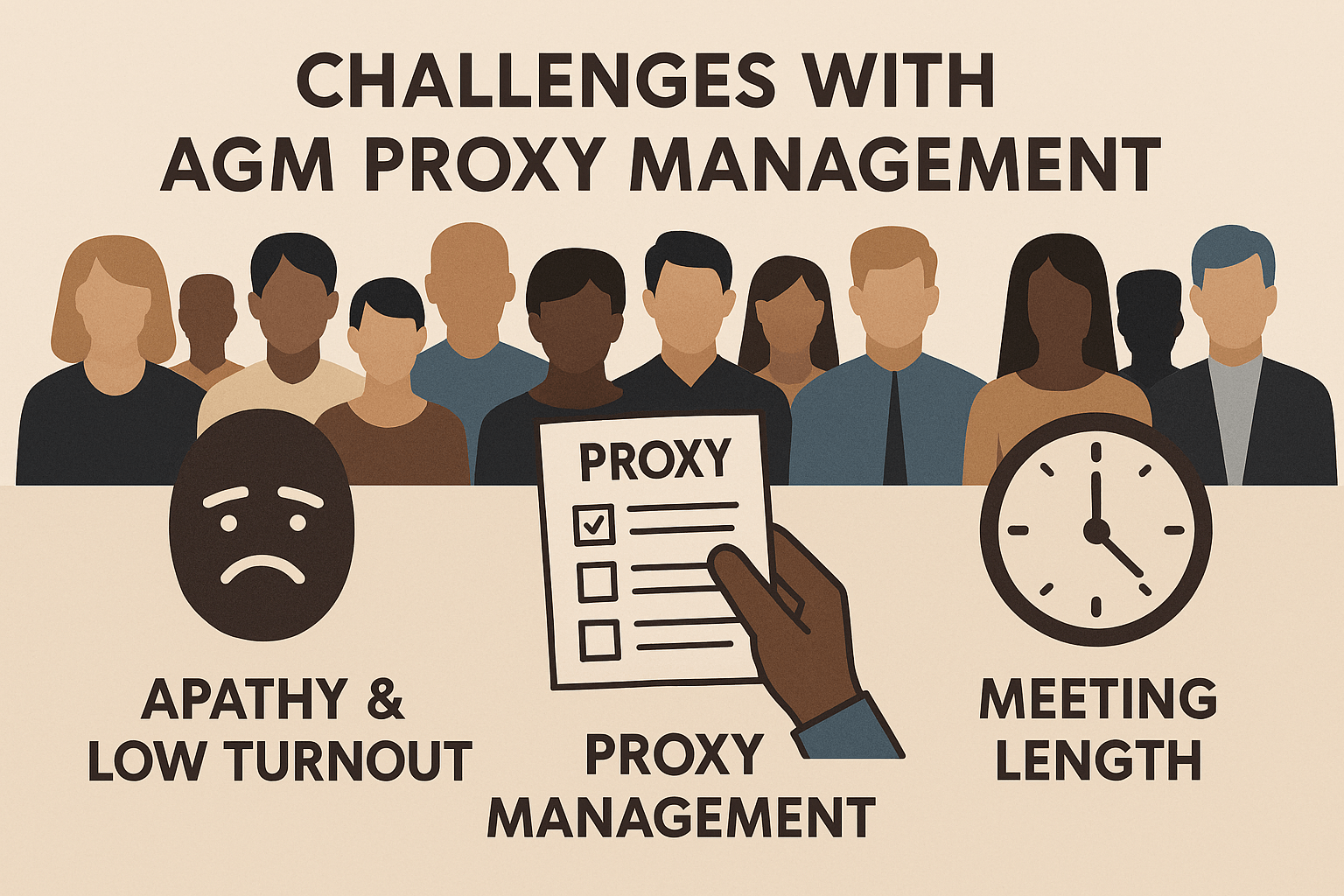
This post unpacks the most common pain points—apathy and low turnout, proxy management, and meeting length—and makes the case for why managers, boards, and owners need a better, more modern system to run meetings and elections.
Author’s Note: My primary experience and expertise are rooted in British Columbia, Canada, where the Strata Property Act governs condominium governance and meeting procedures. However, the challenges discussed—such as owner apathy, proxy management, and meeting logistics—are common across many jurisdictions. Throughout this article, I’ll highlight key differences and parallels in other Canadian provinces and U.S. states, so boards, managers, and owners everywhere can apply these insights within their own legal frameworks.
The participation problem: apathy and low turnout
Low attendance is the root challenge that nearly every condominium/HOA faces. When too few owners show up, quorum can’t be met, business stalls, and costs rise as meetings are adjourned and re‑called. Industry guidance routinely warns boards that failing to achieve quorum forces adjournment and re‑scheduling—wasting money and eroding trust. [1][2]
Because owners are busy (or disengaged), proxies become the “pressure relief valve”: they count toward quorum and let absent owners be represented. But reliance on proxies can create new risks—especially when a small group amasses enough proxies to dominate outcomes (“proxy stacking”). In many jurisdictions, proxy stacking isn’t illegal by itself; the real issue is whether proxies are valid and properly verified. [3]
Why it matters: In large communities, decisions made by a handful of people (or by those holding stacks of proxies) can steer multi‑million‑dollar budgets and major bylaw changes. Clear rules and transparent processes are essential so that representation by proxy enhances—not undermines—democratic legitimacy. [1]
Proxy management: necessary—but messy
Let’s explore a few common questions related to proxy management.
1) What counts as a valid proxy?
The details differ by jurisdiction, but the core rules are consistent: a proxy must be in writing, signed by the voter, and can typically be general or limited (directed). In British Columbia, section 56 of the Strata Property Act (SPA) allows voting by proxy, sets the basic requirements, and prohibits strata managers and strata employees from serving as proxies; courts and guidance also confirm photocopied or faxed proxies can be acceptable. [4]
BC’s official sample Form A shows owners can appoint a general proxy, a meeting‑specific proxy, or even a proxy for a particular resolution—reinforcing that scope and duration should be explicit on the form. [5]
Elsewhere, formats vary. In Ontario, owners must use the mandatory provincial proxy form, which purposely guides them to decide whether the proxy is just for quorum, for procedure only, or for all matters (with or without instructions). [6]
Takeaway: Use the jurisdiction’s prescribed form (where required), and make scope/duration crystal clear on every proxy form.
2) Do proxies survive adjournments?
Owners often ask whether their proxy remains valid if the meeting is adjourned. Because a proxy can be made “general” or meeting‑specific, its continuing validity through adjournments depends on how it’s drafted. BC practice guidance recognizes general and meeting‑specific proxies and that proxies can be revoked at any time—so a well‑drafted general proxy can carry through an adjournment unless the owner limits it. [4][5]
3) Can we limit “proxy hoarding”?
The short answer is NO.
BC law currently does not cap how many proxies one person may hold, which is why “proxy farming” (collecting large numbers) is a recurring concern. The BC Law Institute has even asked whether the Act should be amended to curb proxy farming, acknowledging both the democratic risks and the practical downsides of imposing limits. [7]
CHOA (the Condo Home Owners Association of BC) has long cautioned that bylaws attempting to limit how many proxies a person may hold are not authorized by the SPA—meaning such limitations can be unenforceable. [8]
In the U.S., rules vary by state and by governing documents; in many communities, “proxy stacking” is not inherently illegal, though proper verification and authenticity checks are crucial. [3]
4) Who can see the proxies?
In many U.S. states, proxies are association records owners can inspect (subject to privacy constraints). Regardless of jurisdiction, transparency—paired with data‑protection—helps prevent disputes. [9]
5) Multiple submissions and revocations
Owners sometimes submit more than one proxy (or change their mind). The safe practice is to treat the most recent, properly executed, and dated proxy as controlling (or to include explicit revocation language on the form). Many widely used forms and guides include revocation clauses and explain how owners can revoke or override earlier proxies. [10][11]
Virtual & hybrid meetings: proxies get harder (and longer)
Electronic and hybrid participation increases access—but adds operational complexity. Since November 24, 2022, all BC strata corporations may conduct AGMs/SGMs electronically (or as hybrids) without a special bylaw. Chairs must be able to identify eligible voters attending electronically and enable two‑way communication—requirements that increase registration and facilitation workload. [12]
BC’s general‑meeting guidance also confirms quorum and attendance rules apply equally to in‑person, electronic, and proxy participation [13]—so your registration team must accurately track who’s present, who’s moved from in‑person to proxy mid‑stream, and who’s left the meeting before a vote and now wishes their proxy to be considered.
Event and governance specialists note that hybrid AGMs require more planning and staffing for registration, identity checks, and voting integrity than either fully in‑person or fully virtual formats—another reason long registration lines and extended pre‑meeting delays are so common. [14][15]
Real‑world effect: When two participants each arrive with 100+ proxies in a 600‑unit building, registration alone can take hours. If owners arrive late, leave early, or switch from attending in person to using their proxy, counts must be updated live—further delaying the start time and elongating the meeting.
Quorum, adjournment—and the clock
In BC, business cannot proceed at an AGM/SGM without a quorum (usually one‑third of voting rights unless bylaws set a different threshold). If quorum isn’t reached within 30 minutes of the start time, the meeting stands adjourned to the same day/time the following week; at that reconvened meeting, if quorum still isn’t met within 30 minutes, the eligible voters present (in person, electronically, or by proxy) constitute a quorum. [13][16]
That statutory waiting period is a double‑edged sword: it protects legitimacy but can drag out proceedings and frustrate owners—particularly in large communities where apathy is chronic and registration is slow. [16]
And if process goes sideways—say, irregularities in notice, voting, or conduct of the meeting—the Civil Resolution Tribunal in BC can hear disputes about meeting irregularities and governance, potentially forcing do‑overs that consume more time and money. [17]
Why managers, boards, and owners need a better system?
1) To cut apathy off at the root. Owners are more likely to participate when the process is easy, clear, and quick. Industry guidance shows that just “getting quorum” can be a persistent challenge; accessible voting options (including properly managed proxies and electronic participation) increase engagement and reduce adjournments. [1][2]
2) To make proxies safer and fairer. A modern process should verify identity, track revocations, prevent duplicate counting, respect directed instructions, and produce a clear audit trail that stands up to scrutiny. Without that, communities become vulnerable to proxy disputes and allegations of proxy farming or abuse. [3][9]
3) To shorten meetings. Better pre‑registration, digital credentialing, and real‑time status tracking (attendee leaves → proxy activates) keep registration queues moving, reduce mid‑meeting recounts, and let the actual business begin on time. Hybrid AGMs, in particular, benefit from automated check‑in and vote tabulation designed for mixed attendance. [14][15]
4) To stay compliant across jurisdictions. Requirements differ: BC allows electronic meetings by default; Ontario mandates a specific proxy form; some U.S. states limit or shape proxy use through nonprofit/condo statutes. A system that bakes in local rules reduces legal risk and post‑meeting challenges. [12][6][18]
What “a better system” looks like (a practical blueprint)
A. Owner experience
- Smart, jurisdiction‑aware proxy flows. Present owners only with the legally valid options (e.g., Ontario’s mandatory proxy format), including “quorum only,” “procedure‑only,” or full voting authority with/without directions.
- Plain‑language, neutral instructions. Guidance must be clear—and neutral. In BC, legal commentary warns meeting notices should not solicit proxies in a biased way when controversies are on the agenda. [4]
- One‑click revocation / replacement. Treat the latest, signed proxy as controlling, capture revocations explicitly, and time‑stamp every submission. (Many standard forms include revocation language—mirror that digitally.) [10][11]
- Privacy‑by‑design. Separate PII (name/unit/contact) from voting authority and ballot choices; allow owners to review how their proxy was recorded without revealing others’ information. (Records access rules vary, but transparency with safeguards reduces disputes.) [9]
B. Manager/board console
- Real‑time quorum dashboard that shows present owners (in‑person & electronic), proxies on file, and quorum status by class/section. BC requirements to identify eligible voters in electronic meetings make this essential. [12]
- Dynamic registration & status changes. When an attendee leaves early, the system can automatically activate their proxy (if one exists) or adjust the denominator to reflect current presence—eliminating manual recounts and delays. (Hybrid AGMs are particularly sensitive to this.) [14][15]
- Directed‑proxy enforcement. If an owner gave voting instructions on specific resolutions, constrain the proxy-holder’s ballot accordingly and log exceptions for audit. (Ontario’s format exemplifies this pattern.) [6]
- Jurisdiction packs that encode local rules—BC’s electronic meeting allowances, SPA s.56 proxy rules, Ontario’s mandatory forms—so organizers can’t accidentally run afoul of statute. [12][4][6]
- Edge cases for strata math. Support fractional votes and multi‑unit owners, common in mixed‑use BC stratas—features that general meeting tools often mishandle. [19]
- Audit logs & exportable records in case the CRT (in BC) or a court challenge questions meeting conduct. [17]
C. Security & integrity
- Strong identity verification for electronic attendees and proxy holders (multi‑factor, identity checks) to deter forgery and stacking abuses. [3]
- Tamper‑evident ballots/proxies with time stamps and chain‑of‑custody, so you can prove what counted and when. (Many event governance providers emphasize these controls as standard for modern AGMs.) [15]
Quick wins you can implement before your next AGM/SGM
1) Front‑load clarity. Send the notice package with a jurisdiction‑appropriate proxy form and a one‑page, plain‑English “How to appoint a proxy” explainer. In Ontario, always use the mandatory proxy form[6]; in BC, include Form A or a compliant equivalent. [5]
2) Neutral messaging. If the agenda is contentious, keep the notice and any proxy solicitation neutral to avoid claims of bias. [4]
3) Pre‑validate proxies. Encourage owners to submit proxies ahead of time so staff can review signatures, dating, and scope; reject incomplete forms early rather than at the door. (Many U.S. and Canadian best‑practice guides emphasize signature/date checks.) [9]
4) Staggered registration and clear cut‑off times. For hybrids, open e‑check‑in 30–60 minutes early, publish exact registration and proxy submission cut‑offs, and enforce them so the meeting can start on time. Hybrid or fully electronic AGMs need more buffer to handle identity checks and tech support. [14]
5) Plan for adjournment. If quorum is uncertain, have a reconvene plan pre‑written. In BC, remember the 30‑minute rule and the default reconvened‑meeting provision the following week. [13][16]
A note on fairness vs. flexibility
A common tension is whether to restrict proxies to fight “farming.” In BC, current law doesn’t cap proxy holdings, and attempts to do so by bylaw are fraught; at the same time, legitimate concerns about concentrated power persist. Any reform must balance participation (proxies help reach quorum) against representation (avoiding outsized control by a few proxy holders). Until statutes change, the practical path is verification, transparency, and robust process. [8][7]
Bottom line
AGMs and SGMs should be the most democratic moments in your community’s life—not endurance tests dominated by logistics and paperwork. Apathy and low turnout force overreliance on proxies; weak proxy processes invite disputes; hybrid formats multiply administrative steps; and legal rules (quorum, adjournments, eligible voters) stretch meetings longer.
The fix isn’t just “more reminders.” It’s a better system—one that:
- low‑friction for owners,
- legally aware by design,
- rigorous about identity and audit, and
- built for hybrid reality.
Communities that implement these improvements see shorter meetings, fewer adjournments, cleaner outcomes, and higher trust. That’s a win for managers, boards, and every owner whose home (and investment) depends on decisions made at these meetings. [15][1]
Sources & further reading
- BC Strata: Meetings & Voting — quorum, electronic meetings, voting by proxy (Province of BC). [13][12]
- CHOA (BC) — sample Form A proxy; quorum quick reference; analysis on proxy limitations. [5][16][8]
- Lesperance Mendes (BC) — practical notes on proxies, “restricted proxies,” and electronic participation history. [4][20]
- BC Law Institute — consultation on proxy farming limits. [7]
- CRT (BC) — jurisdiction over meeting irregularities. [17]
- CAI & HOA resources (U.S.) — quorum importance; proxy stacking context. [1][3]
- Ontario CAO & CMRAO — mandatory proxy form and manager obligations. [6][21]
- Hybrid AGM operations — event planning and governance insights. [14][15]
- Revocation & multiple proxies — common form practices and owner guidance. [10][11]
References
[1] hoaresources.caionline.org
[3] hoaresources.caionline.org
[4] lmlaw.ca
[5] choa.bc.ca
[6] www.condoauthorityontario.ca
[7] www.bcli.org
[8] choa.bc.ca
[10] ljlaw.com
[11] www.condocontrol.com
[12] www2.gov.bc.ca
[13] www2.gov.bc.ca
[14] www.encoreglobal.com
[16] choa.bc.ca
[17] www2.gov.bc.ca
[19] propertyflute.ca
[20] lmlaw.ca
[21] cmrao.ca
Streamline your day—Unicli handles the details, you lead the way
Get a personalized demo and overview of Unicli’s benefits.