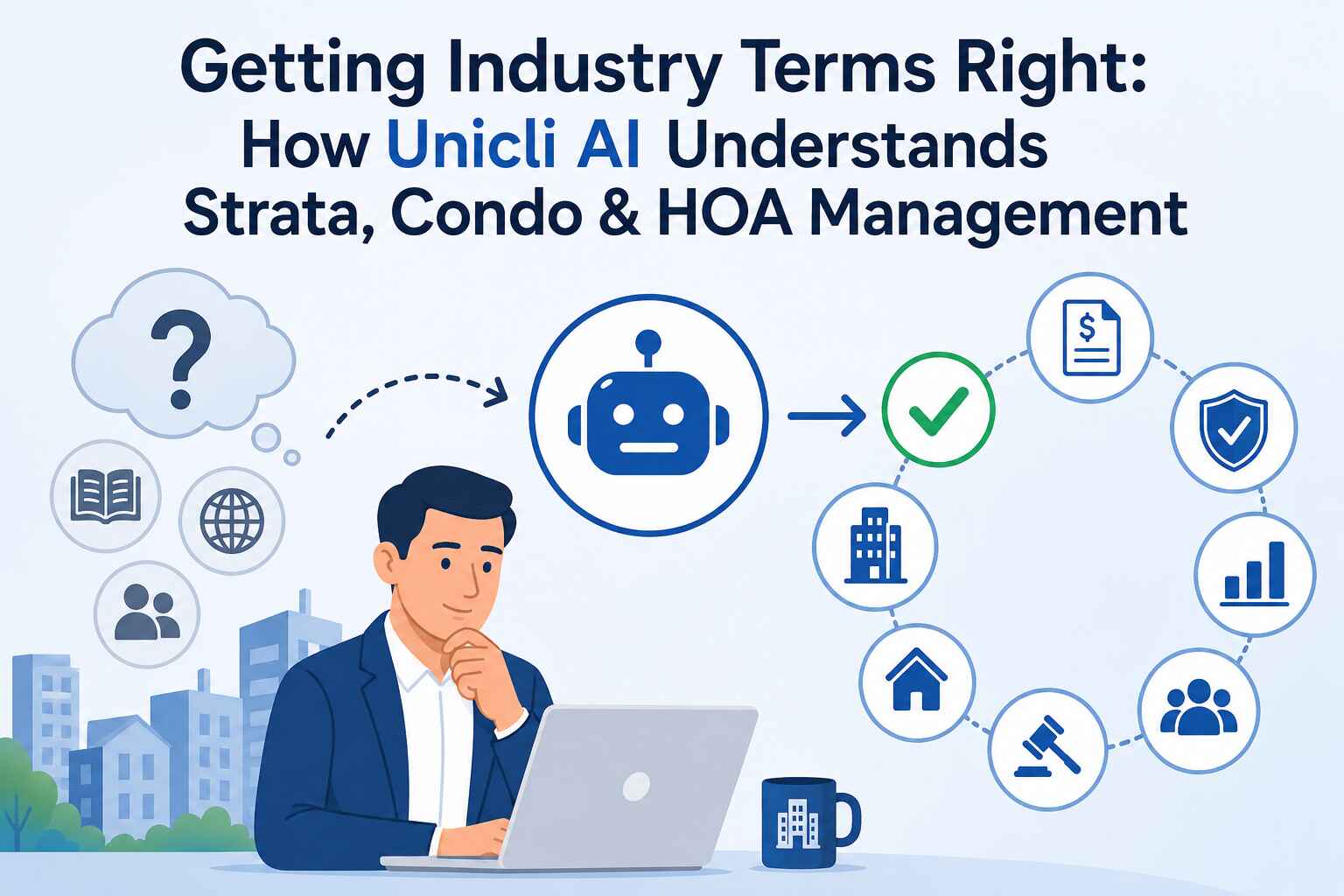
Large Language Models (LLMs) such as ChatGPT are trained on enormous amounts of publicly available text covering virtually every topic imaginable. That broad knowledge is one of their greatest strengths. However, specialized industries often use common words and phrases in very specific ways that differ from their everyday meaning.
Condominium management—whether strata management, HOA management, community association management, or condominium corporation management—has developed its own vocabulary over decades. Many industry terms have meanings that differ from how those same words are commonly used elsewhere.
As a result, when a property manager asks a general-purpose AI a question using industry-specific terminology, the AI may occasionally interpret the term according to its more common meaning rather than its condominium management meaning. This can lead to incomplete answers, incorrect assumptions, or less relevant document retrieval.
Speaking the Customer’s Language Matters
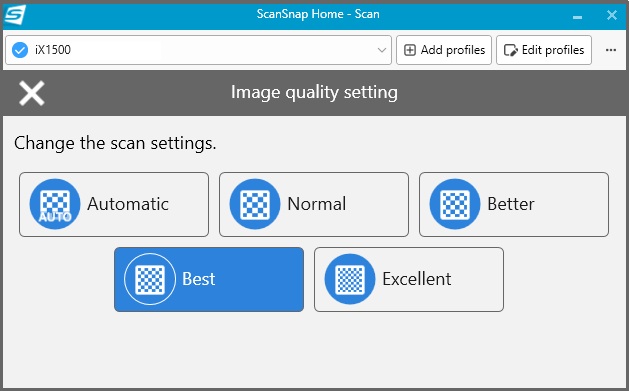
What happens when software doesn’t quite speak the same language as its users.
A humorous example of this can be found in some software products where the developers don’t fully understand the language of their users.
One scanner we use in our office includes image quality settings labeled: Normal → Better → Best → Excellent
At first glance, it seems harmless. But in English, best literally means the highest quality. Nothing should come after it. If Excellent is better than Best, then Best wasn’t actually the best.
Most people immediately recognize the problem: the developer clearly didn’t understand the nuances of the language being presented to customers.
AI faces a similar challenge, although for a different reason.
Modern AI systems are trained on vast amounts of information from countless industries and subject areas. The challenge isn’t that the AI doesn’t know enough—it often knows too much. When a term has one meaning in everyday language and a different meaning within a specialized industry, the AI may default to the more common interpretation.
A good example is the term property manager.
Within the strata, condominium, and HOA management industry, professionals are commonly referred to as property managers. However, in the broader world, the term is more frequently associated with rental property management.
As a result, a general-purpose AI may incorrectly assume that a property manager’s responsibilities involve leasing units, screening tenants, collecting rent, coordinating move-ins and move-outs, or managing landlord-tenant relationships. In reality, a strata manager, condominium manager, or HOA manager serves a very different role, working on behalf of a condominium corporation, strata corporation, homeowners association, board, or council.
At Unicli, we go beyond simply recognizing industry terminology. We also consider the jurisdiction and governing legislation associated with the records being analyzed.
For example, if documents relate to a British Columbia strata corporation governed by the Strata Property Act, the system understands that terms such as strata manager, strata council, strata lot, and Form B may be relevant and have specific meanings. If the records relate to an Ontario condominium corporation governed by the Condominium Act, the system can instead recognize terminology such as condominium manager, board of directors, unit owner, and status certificate.
This industry-specific understanding helps Unicli interpret requests more accurately, retrieve more relevant documents, and provide responses that better reflect how professionals actually use language within the communities they manage.
Why This Matters
Improving AI for condominium management isn’t just about adding more documents. It’s about helping the AI understand the language of the industry.
By continuously refining industry-specific dictionaries, synonym mappings, retrieval rules, document classifications, and search processes, Unicli helps ensure that users receive more accurate answers and more relevant search results. Whether a user asks for “financials,” a “summary of insurance,” a “depreciation report,” or a “Form B,” the goal is simple: help the AI understand what property management professionals actually mean.
As our platform evolves, we continue to identify new terminology patterns and regional variations across strata, condominium, and HOA management to further improve both AI responses and document retrieval accuracy.
Example 1: Financials
Common AI Interpretation
In general business usage, financials may refer broadly to a company’s financial performance, budgets, forecasts, revenue metrics, financial analysis, or financial data.
Condominium Management Interpretation
In the condominium management industry, financials is often used as shorthand for financial statements.
How Unicli Improves Understanding
Our industry-specific dictionaries and synonym mappings recognize that when a property manager asks for financials, they are often seeking financial statements or monthly interim financial reports. This improves both AI-generated responses and document retrieval by connecting the user’s request to the correct records and terminology.
Example 2: Insurance Coverage Information
Common AI Interpretation
A general-purpose AI may interpret insurance coverage information as any information relating to insurance policies, claims, underwriting, exclusions, or risk management.
Condominium Management Interpretation
Within the condominium management industry, Insurance Coverage Information is frequently used interchangeably with Summary of Insurance—a specific document that summarizes the insurance coverage maintained by the corporation or association.
How Unicli Improves Understanding
Our terminology mappings understand that these phrases often refer to the same document type. This allows users to retrieve the correct records regardless of which term they use and helps the AI provide answers based on the appropriate source documents.
Other Examples of Industry-Specific Terminology
The condominium management industry contains many terms that have specialized meanings that may not be immediately obvious to a general-purpose AI system:
Depreciation Report — A long-term capital planning report used in BC strata corporations that estimates the remaining useful life and replacement costs of common property assets.
Council — The elected governing body of a strata corporation. Outside the industry, “council” often refers to a municipal or governmental body.
Strata Lot — An individually owned unit or parcel within a strata development.
Bylaws — The governing rules adopted by a strata corporation, condominium corporation, or HOA.
Reserve Fund / Contingency Reserve Fund (CRF) — Funds set aside for major repairs, replacements, and unexpected expenses.
Information Certificate / Form B — In British Columbia, a standardized disclosure document that provides information about a strata lot and the strata corporation.
Status Certificate — In Ontario, a standardized disclosure document document containing key information about a condominium corporation and a specific condominium unit.
Continuously Improving
We continuously expand and refine our industry-specific terminology models as property managers provide feedback and our subject matter experts identify opportunities for improvement.
The result is an AI platform that understands the language of condominium, strata, and HOA management more accurately than general-purpose AI tools, helping users find the right records, retrieve the right documents, and receive more relevant answers.